

SPC vs WPC Vinyl Flooring: Which Rigid Core Is Better for Calgary Basements
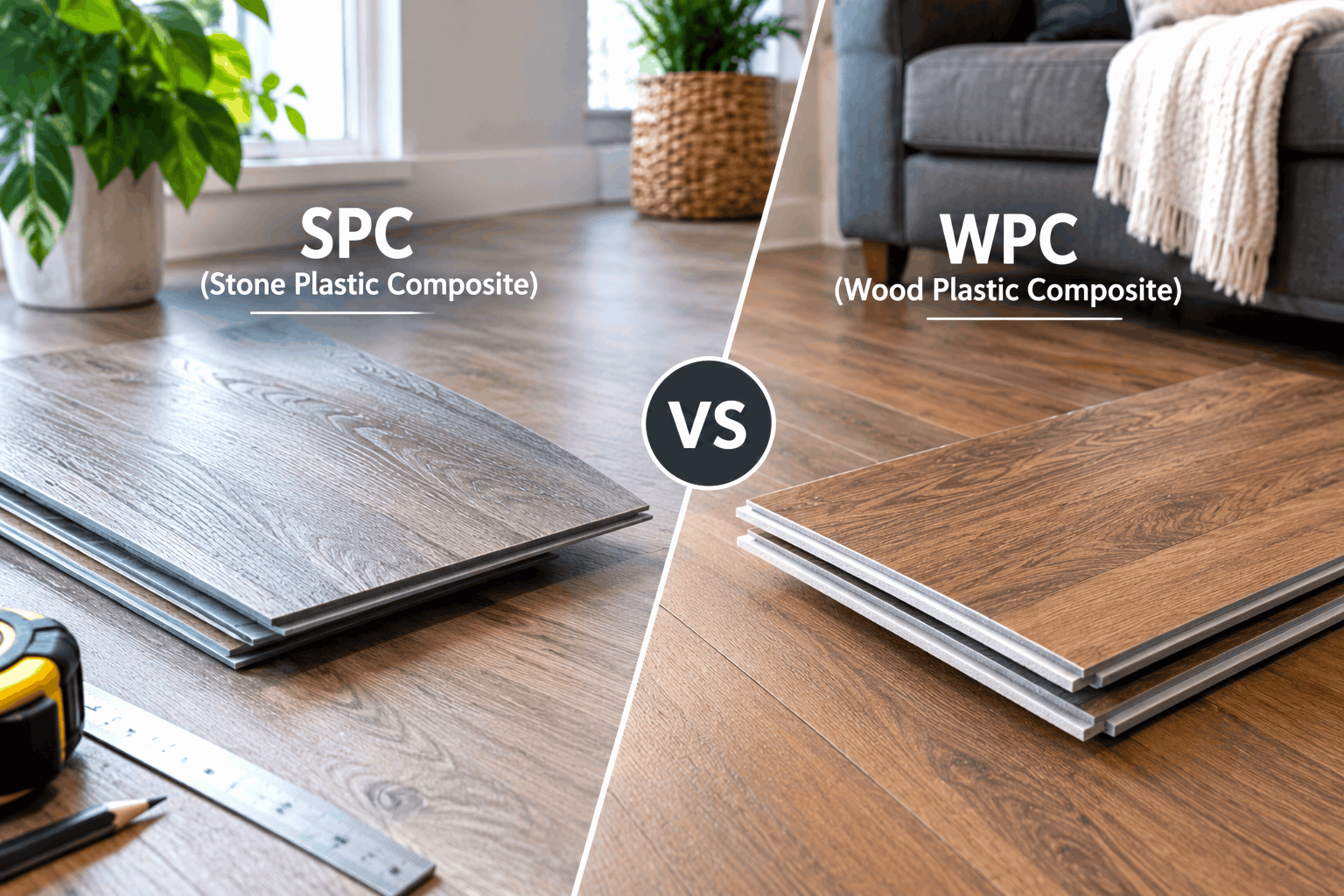
For Calgary basements, SPC (stone plastic composite) is the better choice — its dense, rigid core handles the moisture vapour from concrete slabs and stays dimensionally stable through Calgary's dramatic humidity swings, from under 15% in January to over 50% in summer. WPC (wood plastic composite) is softer and more comfortable underfoot, making it the better pick for above-grade living rooms and bedrooms where comfort matters more than maximum rigidity. As of Q2 2026 in Calgary: SPC runs $6–$11/sq ft installed; WPC runs $7–$13/sq ft installed.
SPC vs WPC: why the core actually matters in Calgary
When you're shopping for luxury vinyl plank, the letters "SPC" and "WPC" get thrown around a lot — often without a clear explanation of what they actually mean for your floor once it's down. Most guides tell you SPC is harder and WPC is softer, and leave it at that. That's technically true, but it misses the part that actually matters for Calgary homeowners.
Here's the thing: Calgary's climate is genuinely unusual. Our furnaces run hard enough through winter to drop indoor humidity below 15% — levels that would be considered a drought in most of the country. Then summer rolls in and we sit at 50–60% relative humidity. Add Chinook events that swing temperatures 20°C in a single day, and you've got a floor that experiences more expansion and contraction stress than almost anywhere else in Canada. On top of that, most Calgary homes have basements sitting on concrete slabs that wick moisture year-round.
In that context, the difference between SPC and WPC stops being a minor technical detail and starts being a decision that affects how your floor performs over a decade. This guide gives you the straight answer — no hedging, no jargon, just what you actually need to know.
SPC vs WPC — what's actually inside each plank
The core difference comes down to what's inside the rigid layer. SPC uses a limestone-and-polymer mix — genuinely dense and almost completely inert. It doesn't care much about moisture or temperature. WPC uses a foamed core with wood fibre and polymers — still far more stable than real hardwood or laminate, but slightly more responsive to the environment than SPC. That foamed layer is also what gives WPC its softer, more comfortable feel underfoot.
Both SPC and WPC have a waterproof core — water won't penetrate the plank itself. But "waterproof plank" and "waterproof installation" are different things. Water can still get through the seams between planks and sit against the subfloor. Neither core fixes a leaking basement or a damp slab. That has to be dealt with before any flooring goes down.
How SPC and WPC actually perform in Calgary's climate
This is where the Calgary-specific detail matters most, and it's what most online comparisons skip entirely because they're written for a generic audience.
Calgary's humidity swings are extreme by Canadian standards. When the furnace runs through January, indoor relative humidity regularly drops to 12–15%. In a humid August it climbs back to 55–60%. That's a 40+ percentage point swing over the course of a year. For any flooring material with organic content — real hardwood, engineered hardwood, even laminate — that kind of cycle causes significant expansion and contraction.
SPC's limestone core is essentially unaffected by humidity. It doesn't absorb moisture, it doesn't expand or contract measurably, and a Chinook event that swings the temperature 20°C in a day is irrelevant to the floor. That's a genuine, measurable performance advantage for Calgary conditions — not marketing language.
WPC's foamed core is still vastly more stable than any wood-based product, but the foam component is slightly more responsive to temperature and humidity. In an above-grade living room with proper HVAC, this difference is negligible. In a Calgary basement with concrete slab moisture and year-round humidity swings, SPC is the more conservative and reliable choice.
Before installing either SPC or WPC in a Calgary basement, do the plastic sheet test: tape a 60×60cm sheet of 6-mil poly flat to the concrete slab and seal all four edges. Leave it for 72 hours. If you find condensation or damp concrete underneath, you have active moisture migration that needs to be addressed before any flooring goes down. SPC handles moisture vapour well — but it's not a fix for a wet or leaking slab.
Full head-to-head comparison for Calgary homes
| Category | SPC | WPC | Winner |
|---|---|---|---|
| Calgary basement performance | Excellent — dense core ignores slab moisture vapour | Good — but foam core slightly more moisture-sensitive | SPC |
| Humidity & temperature stability | Near zero movement through Calgary's seasonal swings | Very stable — still far better than hardwood | SPC |
| Comfort underfoot | Firm — feels solid, not much cushion | Softer, more cushioned — noticeably more comfortable for long standing | WPC |
| Dent & indentation resistance | Excellent — dense core resists furniture legs and equipment | Good — foam core can compress under heavy point loads over time | SPC |
| Noise & sound absorption | Good with attached underlay; firmer underfoot sound | Better — foam core absorbs more impact sound naturally | WPC |
| Subfloor tolerance | Requires flat subfloor — dense core telegraphs unevenness | Slightly more forgiving of minor subfloor imperfections | WPC |
| High-traffic durability | Excellent — rigid core holds up well under constant foot traffic | Good — wear layer quality matters more than core here | Tie (wear layer decides) |
| Installed cost (Calgary Q2 2026) | $6–$11/sq ft | $7–$13/sq ft | SPC |
| Radiant heat compatibility | Excellent — dense core transfers heat efficiently | Good — foam layer slightly reduces heat transfer efficiency | SPC |
All prices estimated Q2 2026 including installation in Calgary. Actual cost varies by product grade, wear layer, and subfloor condition. Contact YYC Floorings for a project-specific quote.
Which one belongs in which room
The honest answer is that the right choice depends more on the room than on which core is theoretically "better." Here's how we actually think about it when a Calgary homeowner asks us:
- Calgary basement (family room, home office, rec room): SPC is the clear recommendation. The dense core handles concrete slab moisture vapour better, stays stable through our humidity cycles, and gives you peace of mind in a below-grade space. Install over a 6-mil poly vapor barrier and an approved underlayment. See our guide to heated floors in Calgary if you're adding in-floor heating — SPC's heat transfer efficiency is an advantage there too.
- Main floor living room or open-plan dining area: Either works well here. If you spend a lot of time on your feet in this space — cooking, entertaining, kids playing — WPC's softer feel makes a real difference over the course of a day. If you have heavy furniture or a lot of foot traffic, lean toward SPC for its dent resistance.
- Kitchen: SPC. Kitchens see constant foot traffic, heavy appliances, dropped items, and spills. The firm, dent-resistant core handles all of this better than WPC's softer foam. The rigidity also means SPC sits flatter under appliances like fridges and dishwashers that sit on the floor for years.
- Mudroom and entryway: SPC. These are Calgary's hardest-working spaces — grit, water, salt, heavy boots, and temperature swings every time the door opens in winter. SPC's density handles the abuse better and holds up under the concentrated traffic of a family entry point.
- Bedroom: WPC is the better call here. Bedrooms see light traffic, no heavy equipment, and minimal moisture risk. The softer, warmer feel of WPC underfoot first thing in the morning is genuinely noticeable — and the extra comfort justifies the small premium over SPC in a room where performance demands are low.
- Home office: SPC if you use a rolling office chair (the firm core resists the point-load wear from casters better). WPC if you're on your feet a lot or do video calls where you want a quieter, softer floor. Either way, use a proper chair mat under a rolling desk chair — no vinyl floor, SPC or WPC, is warranted against rolling caster damage without one.
What a professional SPC or WPC installation looks like in Calgary
Both SPC and WPC need a clean, flat subfloor — but SPC is less forgiving of dips and bumps because its rigidity means it can't flex over imperfections. The standard is 3mm over 1.8 metres. In a Calgary basement, the 72-hour plastic sheet moisture test is mandatory before any flooring goes down. Don't skip this step — moisture issues found after installation are expensive to fix.
Both SPC and WPC should sit in the installation room for 24–48 hours before being laid. This is less critical than with hardwood, but it still matters — particularly if the product was stored in a cold warehouse or delivered in winter. Planks installed at a different temperature than the room can result in joint gaps (installed cold) or joint compression (installed warm). In a Calgary basement that runs 5–8°C cooler than the main floor, ensure the HVAC is running during the acclimation period.
This is the step that catches Calgary homeowners out most often. Many SPC and WPC products come with an attached foam underlayment and explicitly prohibit adding additional underlay — doing so voids the warranty and can cause the click-lock joints to flex and separate over time. Others require a specific underlayment. Check the product's installation guide before buying anything separately. For Calgary basements, confirm whether a vapor barrier is required in addition to (or instead of) the underlayment.
Even though SPC barely moves, it still needs expansion gaps — typically 8–12mm at all walls, door frames, and fixed objects. In Calgary's humidity extremes, this gap prevents any small seasonal movement from creating pressure against the wall. These gaps are covered by baseboards and transition strips and are invisible once the installation is complete. Skipping or undersizing them is the most common reason Calgary homeowners find their vinyl floor buckling in a hot, humid August.
Where your LVP meets a different flooring material — tile in a bathroom, hardwood in a hallway, carpet in a bedroom — a transition strip covers the gap and creates a clean, professional finish. Skipped transitions leave exposed edges that can chip, lift, or trap debris. In Calgary homes where flooring types change between rooms (LVP in the main floor, carpet in the bedrooms), transitions are both a functional and aesthetic requirement.
After installation, sweep or vacuum to remove all debris from cutting and installation. The first damp mop removes the installation dust that settles into the texture of the planks. Use a pH-neutral cleaner specifically approved for LVP — avoid steam mops (heat can damage the click joints), vinegar (too acidic for some wear layers), and anything with wax or oil (leaves a residue that attracts dirt). Keep the warranty, care guide, and installation documentation together for future reference.
What people get wrong about SPC and WPC
Frequently asked questions
Your SPC vs WPC decision checklist for Calgary
- ✓Basement or below-grade? Choose SPC — always
- ✓Comfort a priority? WPC in bedrooms and above-grade living areas where traffic is light
- ✓Heavy furniture or equipment? SPC resists dents and indentation better
- ✓In-floor heating? SPC — better heat transfer, more efficient
- ✓Do the 72-hour moisture test on any Calgary basement slab before installation
- ✓Check the wear layer spec — minimum 20-mil for any busy Calgary household
- ✓Confirm underlayment rules before buying — adding extra underlay to a product with an attached pad voids the warranty
- ✓Leave 8–12mm expansion gaps at all walls — Calgary's humidity swings make this non-negotiable
Not Sure Which Core Is Right for Your Calgary Home?
Bring us the room, the subfloor conditions, and the way you use the space — we'll give you a straight recommendation, not a list of caveats. YYC Floorings supplies and installs SPC and WPC LVP across Calgary, with free in-home consultations and itemised quotes.
Book a Free In-Home Flooring Consultation