

Rubber vs Foam vs Turf Gym Flooring for Calgary Home Gyms: Which One Actually Works?
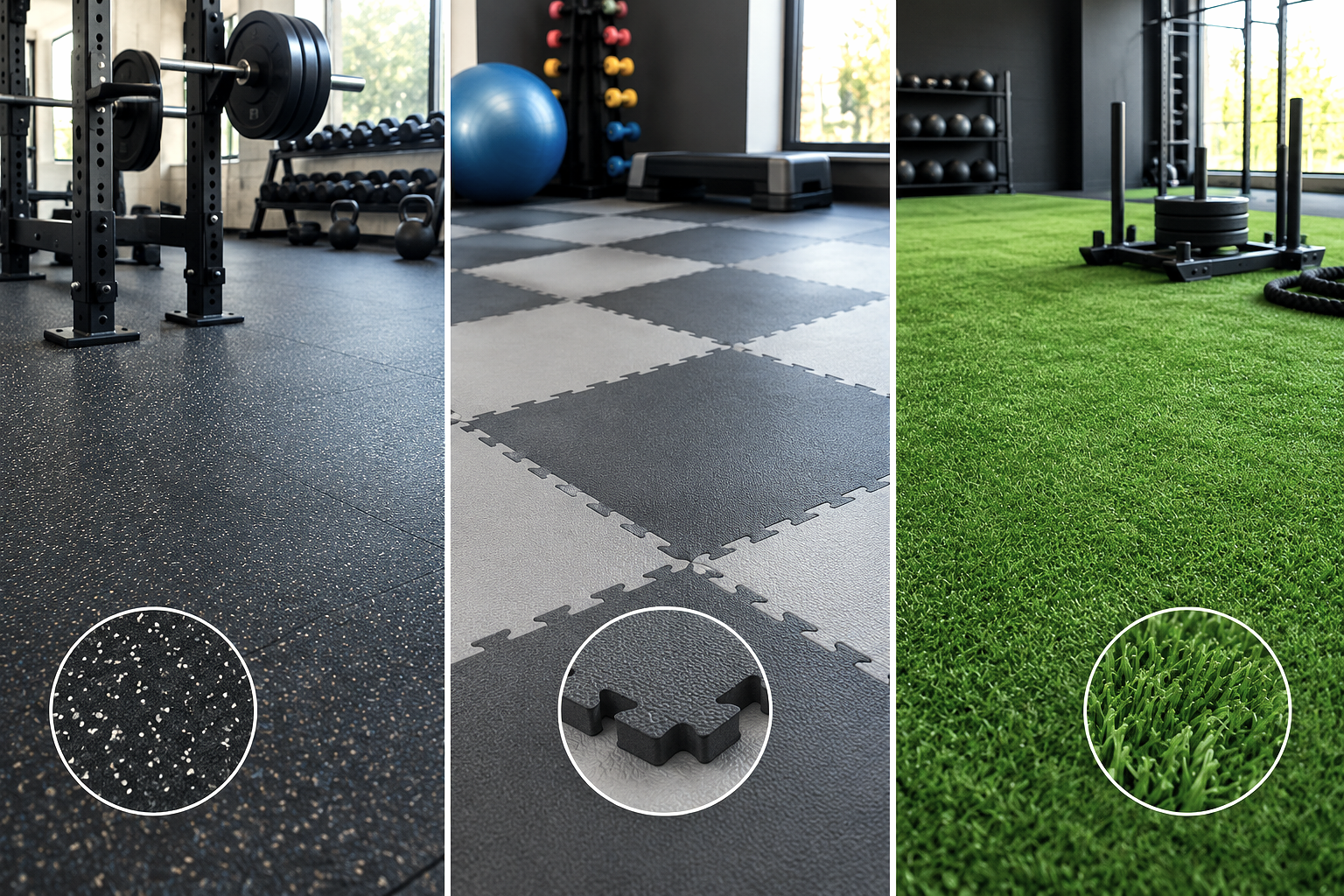
For most Calgary home gyms in 2026, rubber gym flooring is the best all-around choice — especially in garages and basements where temperature swings, concrete slabs, and heavy equipment are a reality. Foam works well for dedicated yoga or stretching areas on a budget. Turf is best for functional training zones (sled pushes, agility drills). The ideal Calgary home gym combines all three: rubber under the weight rack, turf along one wall for conditioning, and foam in a stretching corner. Installed costs: rubber $4–$12/sq ft, foam $1.50–$4/sq ft, turf $8–$16/sq ft.
Why gym flooring matters more in Calgary than most Canadian cities
Building a home gym in Calgary means dealing with conditions most gym flooring guides never consider. Our garages drop to -30°C in January and bake to +35°C in July. Calgary's indoor humidity falls below 15% through most of the heating season — dry enough that foam tiles can crack along their interlocking edges and rubber rolls can temporarily stiffen before warming up. Basements sit on concrete slabs that wick moisture year-round and run 5–8°C cooler than the main floor even in summer.
Add Chinook events — where temperatures swing 20°C or more in a single day — and the thermal stress on any flooring material becomes significant. The right gym floor for a Calgary garage or basement isn't just about comfort and noise reduction; it needs to handle real climate extremes while protecting your subfloor and lasting through years of daily use.
This guide compares rubber, foam, and turf across everything that matters for Calgary home gyms: durability, noise, real 2026 pricing, installation, and climate performance.
The three gym flooring materials compared
All prices estimated Q2 2026 including installation in Calgary. Contact YYC Floorings for an accurate quote for your specific space and layout.
Rubber gym flooring: the right choice for most Calgary home gyms
Rubber gym flooring — available in tiles, rolls, and interlocking mats — is the most popular and most practical choice for Calgary home gyms. Vulcanized rubber (both virgin and recycled) holds up under repeated heavy impacts, resists compression from equipment legs, and handles temperature swings that would degrade foam in a season.
Rubber gym flooring performs in Calgary garages where foam cannot. High-quality rubber remains flexible at -20°C and doesn't crack at the seams the way EVA foam does through freeze-thaw cycles. It also provides genuine insulation from cold concrete — a 15mm rubber mat creates a meaningful thermal barrier between your feet and a -10°C garage slab in January. For any unheated or minimally-heated Calgary garage gym, rubber is the only practical choice.
Thickness guide for rubber gym flooring:
- 8mm: Light use, cardio machines, stretching areas — budget option
- 12–15mm: General home gym use, moderate weights, Calgary basement standard
- 20–25mm: Heavy weightlifting, Olympic lifting, dropped weights — garage gyms
- 38mm+: Deadlift platforms and power rack footprints — premium protection
New rubber gym flooring — especially recycled rubber rolls — has a strong odour that can be overpowering indoors for the first 2–4 weeks. In a Calgary basement, ventilate aggressively during this period: open windows, run fans, and consider a temporary dehumidifier. The smell dissipates completely over time and is not harmful, but it is intense enough to make the space unusable for extended workouts in the first few weeks if unventilated.
Foam gym flooring: the right choice for light use and yoga spaces
EVA foam interlocking tiles are affordable, easy to install without tools, and comfortable underfoot for floor-based exercise. For a dedicated yoga room, a stretching corner, or a child's play-and-exercise area in a conditioned indoor space, foam is a practical and cost-effective choice.
EVA foam gym tiles are not suitable for unheated or minimally-heated Calgary garages. Below approximately -5°C, EVA foam becomes brittle and the interlocking edges crack and separate with the contraction. After a few freeze-thaw cycles, the tiles no longer interlock cleanly and the floor becomes uneven and hazardous. If your gym space drops below freezing in winter, rubber is the only viable choice.
Foam also fails under heavy equipment. A 45lb plate dropped from overhead will punch through or permanently compress a foam tile. Foam under a squat rack or power cage will deform under the static weight over weeks, creating an uneven and potentially unstable surface. Use rubber anywhere weights are involved — foam only where the heaviest thing hitting the floor is a yoga mat.
Gym turf flooring: the right choice for functional training zones
Artificial gym turf — shorter-pile (12–25mm), non-infill products designed specifically for fitness — creates a grippy, durable surface for the movements that don't work well on rubber or foam: sled pushes, battle ropes, agility ladder drills, sprint starts, and bear crawls. The textured surface locks footwear in place during lateral movements and gives a sled something to push against.
Gym turf works well in Calgary basement gyms — it's dimensionally stable in our humidity range, easy to clean (shop vac + occasional damp mop), and creates a premium-looking training zone that photographs well. Install over a 6-mil poly vapor barrier on concrete slabs to prevent moisture wicking through to the turf backing. Short-pile turf (12–15mm) is easier to drag equipment across and more practical than long-pile landscaping turf for gym use.
Turf is not ideal for floor exercises that require lying down (yoga, mobility work, or stretching) — it's uncomfortable for prolonged contact and gets warm in a heated basement gym. Pair it with a rubber or foam zone for floor-based work.
Full comparison: rubber vs foam vs turf for Calgary home gyms
| Feature | Rubber | Foam | Turf |
|---|---|---|---|
| Installed cost (2026) | $4–$12/sq ft | $1.50–$4/sq ft | $8–$16/sq ft |
| Durability | 10–20 years | 3–5 years | 8–15 years |
| Heavy weight protection | Excellent | Poor — dents & tears | Good with rubber under rack |
| Noise & vibration reduction | Excellent | Medium | Medium |
| Calgary garage performance | Excellent | Poor — cracks in cold | Good |
| Calgary basement performance | Excellent | Good (conditioned only) | Excellent |
| DIY installation | Moderate (tiles); hard (rolls) | Easy — interlocking tiles | Moderate |
| Floor exercises (yoga, stretching) | Good | Best | Poor |
| Sled & agility training | Good | Poor | Best |
The hybrid approach: the best Calgary home gym setup
Most experienced Calgary home gym owners end up with a combination of all three materials, each in the zone where it performs best. This hybrid approach covers every training style without compromise — and often costs less than covering the entire space in premium rubber.
240 sq ft rubber (weightlifting area + general floor) at $7/sq ft = $1,680 · 100 sq ft turf (one wall) at $11/sq ft = $1,100 · 60 sq ft foam (stretching corner) at $2.50/sq ft = $150 · Total: approximately $2,930 — a complete, professional-feeling home gym covering every training need. Adjust proportions based on your primary training focus.
Installing rubber gym flooring in a Calgary basement: 6 steps
Calgary basement slabs wick moisture year-round. Before laying any gym flooring, tape a 60×60cm sheet of 6-mil poly to the slab and seal all four edges with tape. Leave it for 72 hours. If you find condensation or damp concrete underneath, address the moisture source before installing — no gym flooring, rubber included, will solve active water intrusion. Most rubber tile products tolerate incidental moisture but perform better over a dry slab.
Remove all debris, dust, and any existing flooring adhesive. Check for high spots and dips using a long straightedge — rubber tiles, especially 8–12mm, will telegraph significant unevenness underfoot and can cause interlocking edges to separate over time if the slab isn't reasonably flat. Use self-leveling concrete compound for dips greater than 6mm over a 1.8m span. Allow 24 hours minimum cure time.
This step is especially important in Calgary garages and cold basements. Rubber delivered in winter can arrive at near-freezing temperatures and will be stiff and difficult to lay flat. Allow rubber tiles or rolls to sit in the installation space at normal temperature for at least 24–48 hours before installation. Rolls in particular need this time to relax and lie flat — installing a cold, stiff rubber roll will result in edges that curl upward.
Start from the centre of the room and work outward so that cut tiles at all four walls are equal in size — this looks professional and prevents narrow slivers at one edge. Dry-lay the first few rows before committing to the layout. For rolls, plan the seam direction so it runs parallel to the longest wall and away from high-traffic paths through the space.
Interlocking rubber tiles click together without adhesive and allow for future removal or reconfiguration — ideal for renters or anyone who may want to change the layout. Rubber rolls require a full-spread adhesive (contact cement or pressure-sensitive adhesive rated for rubber) for a permanent installation. Leave a 6–10mm expansion gap at all walls — rubber expands slightly in Calgary's warmer, more humid summers.
Freshly installed rubber — especially adhesive-set rolls — needs time to fully bond and settle. Allow 24–48 hours minimum before light use and 3–5 days before placing a power rack, squat rack, or heavy cardio machines. This gives the adhesive full cure time and allows tiles to settle under their own weight before adding point-load stress from equipment legs.
Common myths about gym flooring for Calgary home gyms
Frequently asked questions
Your Calgary home gym flooring checklist
- ✓Test the concrete slab for moisture before any installation — 72-hour poly sheet test minimum
- ✓Use rubber (15–20mm minimum) in any unheated or minimally-heated Calgary garage — foam will crack in winter
- ✓Use rubber under all weight equipment regardless of what other materials are elsewhere in the gym
- ✓Allow 24–48 hours acclimation for rubber tiles or rolls delivered in Calgary's cold months
- ✓Choose fitness-specific turf (no infill, short pile 12–25mm) — not landscaping artificial grass
- ✓Leave a 6–10mm expansion gap at walls for rubber flooring — it expands in Calgary's humid summers
- ✓Consider a hybrid layout — rubber + turf + foam covers all training needs at lower total cost than premium rubber throughout
- ✓Check condo bylaws before installing a weightlifting area — many Calgary buildings restrict impact noise
Ready to Build Your Calgary Home Gym?
YYC Floorings supplies and installs rubber gym flooring, foam tiles, and gym turf across Calgary — from single-zone installs to full hybrid home gym builds in garages and basements. We'll help you choose the right material, thickness, and layout for your training style and space.
Book a Free Home Gym Flooring Consultation