Nylon vs Polyester vs Wool Carpet: A Guide to Carpet Fibre Types for Calgary Homes
Quick Answer
For most Calgary families, nylon is the right call for stairs, hallways, and family rooms — it handles foot traffic, kids, and pets better than any other carpet fibre. Polyester is the smart, affordable choice for bedrooms and guest rooms where comfort matters more than durability. Wool is a genuine long-term investment for homeowners who want natural luxury and are committed to proper care. As of Q2 2026 in Calgary: nylon runs $4–$12/sq ft installed, polyester runs $3–$8/sq ft installed, and wool runs $9–$20+/sq ft installed.
The carpet fibre types Calgary homeowners actually need to know
When most people walk into a carpet showroom, the first thing they do is kick off a shoe and press a foot into the samples. The softest one wins. That instinct makes sense — you’re going to walk on this floor every day — but it’s also how a lot of Calgary families end up replacing carpet far sooner than they expected.
The softness you feel on a showroom floor in November is not what the carpet will feel like in your hallway in three years. What actually determines how a carpet holds up is the fibre it’s made from — specifically, how that fibre responds to foot traffic, spills, Calgary’s bone-dry winter air, and whatever your household throws at it daily. The three main carpet fibre types Calgary flooring stores carry are nylon, polyester, and wool — and each one suits a different combination of room, budget, and lifestyle.
Calgary’s furnaces run hard enough from November through March that indoor humidity regularly drops below 15%. That extreme dryness creates static electricity in synthetic carpets, makes wool more prone to drying out and becoming brittle if the humidity swings too dramatically, and accelerates wear in low-density pile that wasn’t built for it. Add Chinook events that swing the temperature 20°C in a day, and your carpet is dealing with an unusual climate even before anyone walks on it.
This guide gives you the straight-talk version: what each fibre actually does well, where it struggles, how much it costs in Calgary right now, and which rooms it belongs in.
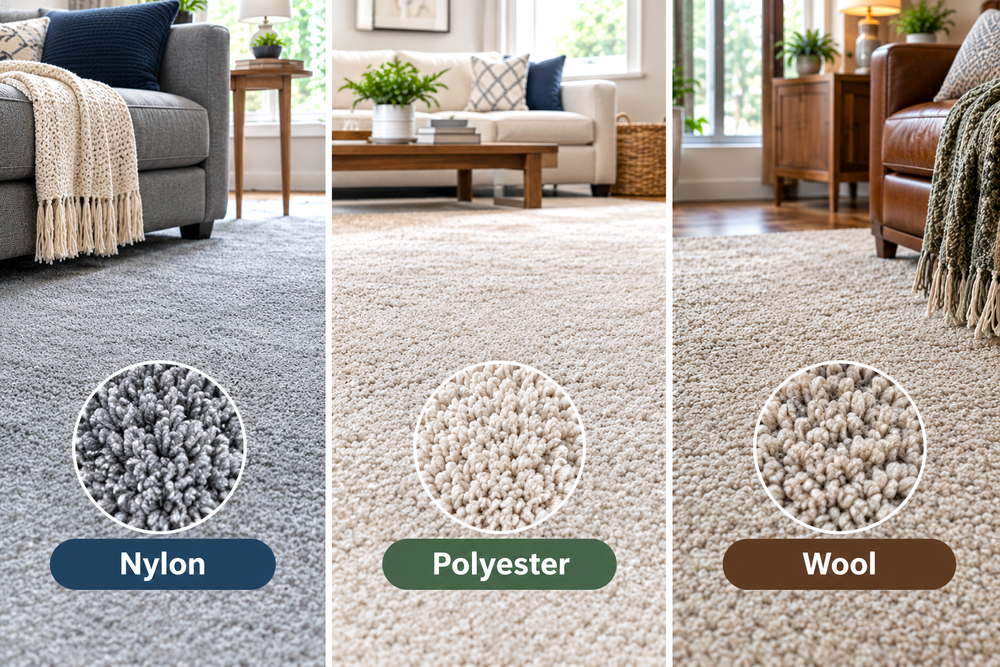
The three main carpet fibres at a glance
Best All-Rounder
💪
Nylon Carpet
Durability: Excellent
Crush resistance: Excellent
Stain resistance: Good (with treatment)
Installed (2026): $4–$12/sq ft
Best rooms: Stairs, hallways, family
Best Value
✨
Polyester Carpet
Durability: Fair to good
Crush resistance: Fair to good
Stain resistance: Excellent (water-based)
Installed (2026): $3–$8/sq ft
Best rooms: Bedrooms, guest rooms
Premium Choice
🌿
Wool Carpet
Durability: Excellent (with care)
Crush resistance: Good to excellent
Stain resistance: Good (prompt care needed)
Installed (2026): $9–$20+/sq ft
Best rooms: Bedrooms, formal living
All prices Q2 2026, installed (materials + labour + standard underpad). Actual cost varies by pile height, density, stair count, and subfloor condition. Contact YYC Floorings for a project-specific quote.
Nylon carpet — why it’s the workhorse fibre
If you have kids, a dog, or a staircase that gets used every single day, nylon is probably the right answer before you even look at colours. Its biggest strength is resilience — the ability to spring back after being compressed. When foot traffic pushes carpet pile flat, nylon recovers better than any other fibre. That’s why staircase carpet and hallway carpet almost always performs better in nylon: those are the spots where traffic is concentrated and pile crushing happens fastest.
Nylon also takes dye well, which means it’s available in the widest range of colours and patterns. And it handles professional cleaning better than polyester — important in Calgary where furnace dust, pet hair, and grit from icy sidewalks all end up in your carpet from October through April.
💡 Calgary Tip — Check the Stain Treatment
Nylon itself isn’t naturally stain resistant — the fibre is treated with a stain-repellent finish during manufacturing. Check whether that treatment is included in the warranty and whether it’s a surface coating (which wears off) or built into the fibre. Brands like Stainmaster and Scotchgard use different approaches. Ask before you buy.
The main trade-off with nylon is cost. Entry-level nylon starts around $4/sq ft installed, but mid-range and premium nylon with better pile density and twist can push $10–$12/sq ft installed. For a whole-house carpet job in a typical Calgary home, that difference adds up quickly. The counter-argument: a quality nylon carpet in a busy hallway can last 15–20 years. A polyester carpet in the same spot might need replacing in 8–10.
Also worth knowing: nylon generates more static electricity than other fibres in dry conditions. Calgary winters, with indoor humidity regularly dropping to 12–15%, can make this noticeable — that snap when you touch a doorknob. It’s manageable with a humidifier and an anti-static underpad, but it’s real.
Polyester carpet — where it earns its place
Polyester gets a bad reputation in the flooring industry, partly because cheap polyester carpets really do flatten quickly in high-traffic areas. But that’s not the full picture. In the right room, polyester is genuinely excellent — and it’s often the smartest choice a Calgary homeowner can make.
The key advantage polyester has over nylon is stain resistance. Polyester fibres don’t readily absorb water-based liquids, which means spills — the glass of juice, the knocked-over coffee — bead on the surface long enough to blot up cleanly. This is a natural property of the fibre, not a treatment that wears off. For a guest bedroom or a kid’s bedroom where foot traffic is light but the occasional spill is a given, polyester often outperforms nylon on the thing that matters most.
Worth Knowing
Many modern polyester carpets are made from recycled PET plastic bottles — the same material as water bottles. This is a genuine sustainability advantage over nylon, which is petroleum-derived. If environmental impact matters to your buying decision, look for carpets that specify recycled PET content.
Polyester also holds colour vibrantly. If you want a rich, bold carpet colour — deep navy, forest green, saturated terracotta — polyester often delivers a more vivid result than nylon at a similar price point.
⚠️ Where Polyester Struggles
Polyester’s weakness is oily stains — cooking oil, pet grease, certain lotions. These bond to the fibre in a way that water-based stain resistance can’t prevent. If your carpet is going in a room where oily residues are likely (near a kitchen, or in a room where pets groom themselves regularly), factor this in. Nylon with a good stain treatment handles oil better.
Stain resistant carpet — what that label actually means in 2026
Every carpet manufacturer uses “stain resistant carpet” in their marketing, but the term means different things depending on the fibre. Understanding what you’re actually buying saves a lot of frustration when something gets spilled.
Polyester is inherently the most stain resistant carpet option for water-based spills — it’s built into the fibre itself and doesn’t wear off over time. That’s a genuine advantage and one reason polyester is our first recommendation for kids’ rooms and guest bedrooms. The caveat, as covered above, is oil-based stains, where polyester’s natural resistance doesn’t apply.
Nylon requires a stain treatment to perform as a stain resistant carpet. The quality of that treatment varies significantly between manufacturers. Surface coatings (like older Scotchgard applications) wear down with foot traffic and cleaning; built-in fibre treatments (like those in Stainmaster or solution-dyed nylon) last much longer. When you’re comparing nylon products, ask specifically whether the stain resistance is a surface treatment or part of the fibre construction — that question alone tells you a lot about the product’s long-term performance.
Wool has natural lanolin-based soil resistance that helps with everyday dust and dry dirt, but it’s not a stain resistant carpet in the way that polyester is. Spills need to be blotted immediately and cleaned with wool-safe, low-moisture products. The lanolin helps — it just requires a faster response time than synthetic options.
💡 Stain Resistant Carpet Tip for Calgary Families
No matter which fibre you choose, the most effective stain management strategy is speed. A spill blotted within 30 seconds on any carpet fibre has a far better outcome than a spill left for five minutes — even on a “stain resistant carpet” with full manufacturer treatment. Keep a clean white cloth and a pH-neutral carpet spotter in a kitchen drawer. The faster you get to it, the less the fibre matters.
Wool carpet in Calgary — what makes it worth the premium (and what doesn’t)
Wool carpet Calgary homeowners install tends to fall into two camps: people who researched it carefully and love it, and people who bought it without understanding the maintenance and regret it. The difference almost always comes down to choosing the right room and committing to the right care routine. Wool carpet is genuinely different from synthetic options in a way that’s hard to describe until you’ve stood on a quality wool carpet for a few minutes. There’s a density and warmth to it — not just physically warm underfoot, but visually warm in a way that photographs beautifully and ages gracefully. A quality wool carpet in a formal living room or primary bedroom doesn’t just hold up over decades; it develops character.
From a performance standpoint, wool’s natural lanolin coating gives it some inherent soil resistance. Dry dirt doesn’t bind to the fibre the way it does in synthetics, which means regular vacuuming actually removes more of it. Quality wool also has good resilience — better than people often expect — and wool carpet from reputable manufacturers can last 20–30 years in the right conditions.
⚠️ Wool + Calgary Winters — What You Need to Know
Wool is a hygroscopic fibre — it absorbs and releases moisture from the air. Calgary’s furnace-driven winters, where indoor relative humidity regularly drops to 12–15%, can cause wool carpet to lose moisture, become slightly more brittle, and generate static. This doesn’t mean wool fails in Calgary — it means you need a humidifier running through winter (which you probably should anyway for your hardwood and your own health) and you should avoid any cleaning method that over-wets the fibre. Low-moisture cleaning is non-negotiable with wool.
Wool is also the most expensive option by a significant margin. Mid-range wool carpet runs $12–$16/sq ft installed in Calgary; premium wool from New Zealand or the UK can push $20/sq ft and beyond. For a 1,000 sq ft carpet project, the difference between mid-range nylon and quality wool can easily be $8,000–$12,000. That’s a real number, and it only makes sense if you’re in a home you plan to stay in, the room sees light traffic, and you’re genuinely committed to the maintenance it requires.
Full head-to-head comparison
| Category | Nylon | Polyester | Wool |
|---|---|---|---|
| Long-term durability | Excellent — 15–20+ years in busy areas | Fair — 8–12 years in high-traffic spots | Excellent — 20–30 years with proper care |
| Crush & traffic resilience | Excellent — best pile recovery of all three | Fair — shows traffic lanes sooner in dense-use areas | Good — quality wool recovers well when maintained |
| Water-based stain resistance | Good — depends on stain treatment quality | Excellent — natural fibre resistance, no treatment needed | Good — lanolin helps, but blot immediately |
| Oil-based stain resistance | Good with quality stain treatment | Poor — oil bonds to polyester fibres | Moderate — needs professional treatment for oils |
| Pet households | Best choice — resilience + cleanability | Good for low-traffic pet rooms | Use with caution — moisture, odour risk |
| Comfort underfoot | Good | Very good — often softer than nylon at same price | Excellent — natural warmth and density |
| Calgary winter static | Notable — manage with humidifier + anti-static pad | Moderate — less than nylon | Low — natural fibre, less static-prone |
| Installed cost (Calgary Q2 2026) | $4–$12/sq ft | $3–$8/sq ft | $9–$20+/sq ft |
| Colour range | Very wide | Very wide, vibrant | Natural/refined tones — limited range |
| Eco credentials | Synthetic — petroleum-derived | Often recycled PET — positive sustainability story | Natural, renewable, biodegradable |
Which fibre belongs in which room
- 🚶: Staircase: Nylon, every time. Stairs concentrate foot traffic on the nose (the front edge of each step) more intensely than any other carpeted surface. That’s where pile crushing, fibre breakdown, and wear show up first. The resilience of nylon is exactly what a staircase needs. A dense, tightly-twisted nylon carpet with good pile weight will outlast polyester on stairs by years. See our guide to staircase flooring in Calgary for full guidance on pile height, pattern matching, and runner vs. wall-to-wall options.
- 🚪: Hallways and entryways: Nylon. Same logic as stairs — concentrated, repetitive traffic in a narrow path. Calgary hallways also take a beating from winter boots and grit tracked in from icy sidewalks. Nylon’s ability to clean thoroughly is as important here as its durability.
- 👨👩👧: Family room / living room: Nylon for active families with kids and pets; high-end polyester or wool in adult-primary homes with lighter traffic. If your family room is where the dog sleeps, the kids do crafts, and movie nights happen weekly, nylon’s resilience justifies the extra cost. If it’s a formal living space that sees a few guests on weekends, a quality polyester or wool makes a strong case.
- 🛏️: Primary bedroom: Any of the three, based on budget and preference. Bedrooms see light traffic, minimal spill risk, and are where the sensory experience of carpet matters most. Wool is genuinely exceptional in a primary bedroom — the warmth and density underfoot on a cold Calgary morning is noticeable. If budget is a constraint, a high-quality polyester delivers a similar feel at a third of the cost.
- 🛁: Kids’ bedroom: Polyester. Bedrooms see light foot traffic, but kids’ rooms often see more spills, art projects, and dropped snacks than adult bedrooms. Polyester’s natural water-based stain resistance handles this well, and the lower cost means you’re not heartbroken if the carpet ends up needing replacement in 10 years when the room gets repurposed.
- 🏡: Basement: Carpet in Calgary basements comes with a caution flag for all three fibre types. Moisture vapour migrating upward through concrete slabs is the issue — and any carpet fibre that holds moisture for too long can develop mold or mildew underneath, regardless of how resistant the fibre itself is. If you’re set on carpet in the basement, use nylon or polyester over a quality moisture-resistant underpad, and deal with any slab moisture issues before the carpet goes down. We generally recommend SPC LVP over carpet for Calgary basements — but it’s your call.
How to buy carpet without regretting it six months later
1
Start with the room’s traffic level, not the colour
Before you look at anything else, be honest about how the room is actually used. A hallway with two adults and no pets is completely different from a family room with three kids, a dog, and a cat. Your traffic assessment determines whether you’re shopping in the nylon category or whether polyester is genuinely fine.
2
Look at pile density and twist, not just total thickness
Two carpets can be the same total thickness (say, 12mm) but have completely different durability. Denser pile (more fibre per square inch) and tighter twist (how many times per inch the yarn is twisted) both predict how the carpet holds up under traffic. A dense, tightly-twisted mid-grade nylon will outlast a fluffy, loosely-twisted premium nylon at the same price point. Bend the sample back — if you see the backing easily, the pile is too loose for a high-traffic area.
3
Check the warranty — all three components of it
A good carpet warranty covers three separate things: the fibre warranty (how long the manufacturer stands behind the fibre itself), the stain warranty (what types of stains are covered and for how long), and the wear warranty (when the carpet is considered worn out). Read all three. A 25-year “lifetime” warranty that excludes pet stains and high-traffic wear isn’t the safety net it appears to be. Ask what voids the warranty — many require professional cleaning every 12–18 months to stay valid.
4
Don’t skip the underpad
A quality underpad does three things: it makes the carpet feel more comfortable underfoot, it absorbs impact and reduces wear on the carpet backing, and it insulates against sound and cold (important in Calgary basements and ground-floor rooms in January). The underpad the installer provides as “standard” is often the thinnest acceptable option. Ask what they’d put in their own home. A $1.50/sq ft upgrade on the underpad is often one of the best investments you can make in the total carpet installation.
5
Ask about seam placement before installation day
Carpet comes in standard widths (typically 12 feet). Any room wider than that will have seams — the critical question is where they land. Seams in doorways, in the middle of a traffic path, or in a spot that gets direct sunlight will show and wear faster. A good installer plans seams deliberately, placing them along walls, under furniture, or away from high-traffic zones. Ask to see the layout plan before they start cutting.
What people get wrong about carpet fibre
❌ “The softest carpet in the showroom is the best carpet”
✓ Softness in the showroom often comes from loose, low-density pile — exactly the construction that flattens fastest under foot traffic. The carpet that feels luxurious when you press your palm into it can look beaten and matted in a busy hallway within two years. Match the construction to the traffic level first; softer options within the right construction category can come second.
❌ “Polyester carpet is always inferior to nylon”
✓ Polyester has a real weakness in high-traffic areas — its crush resistance is genuinely lower than nylon. But in a bedroom or a guest room, that weakness is irrelevant. In those rooms, polyester’s natural stain resistance and lower price make it the smarter buy. The problem isn’t polyester; it’s polyester in the wrong location.
❌ “Wool carpet can’t handle Calgary’s dry winters”
✓ Wool is moisture-sensitive, but that doesn’t mean it fails in Calgary. It means you need to maintain reasonable indoor humidity (40–50% RH is ideal for both the carpet and your wood furniture), avoid over-wetting during cleaning, and vacuum consistently. Wool carpet has been successfully installed in Calgary homes for decades. The issue is neglect and improper cleaning, not the climate itself.
❌ “Stain-resistant carpet means stain-proof carpet”
✓ No carpet is stain-proof. “Stain-resistant” means the fibre or treatment gives you more time — often 15–30 seconds to a few minutes — before a spill absorbs into the fibre. After that window, the stain behaves like any other. Quick cleanup is still required with every fibre type, regardless of what the warranty says. The warranty is for what you can’t save; the goal is to save it before it needs saving.
❌ “You only need professional cleaning if the carpet looks dirty”
✓ Carpet looks clean long after it’s stopped being clean. Fine grit, skin cells, pet dander, and allergens accumulate deep in the pile and are invisible to the eye. By the time a carpet visibly looks dirty, it’s carrying several times more contamination than it should. Most manufacturers recommend professional hot-water extraction every 12–18 months — not because it’s a sales tactic, but because it’s what the fibre needs to last the full warranty period.
Frequently asked questions
Which carpet fibre is best for pets and kids in a Calgary home?
Nylon is the best all-round choice for households with kids and pets in Calgary. Its superior resilience handles the concentrated traffic that comes with an active family, and it cleans thoroughly under professional extraction — important when you’re dealing with pet hair, tracked-in grit, and the occasional accident. Look for a nylon carpet with a quality stain treatment, a dense pile construction, and a tight twist. For pet households specifically, consider a slightly lower pile height — it’s harder for pet hair to embed and easier to vacuum clean.
How much does carpet installation cost in Calgary in 2026?
As of Q2 2026 in Calgary, fully installed carpet (materials + underpad + labour + basic subfloor prep) runs: polyester $3–$8/sq ft, entry-level nylon $4–$6/sq ft, mid-range nylon $6–$10/sq ft, premium nylon $10–$12/sq ft, and wool $9–$20+/sq ft. For a typical Calgary main floor carpet project of 800–1,000 sq ft, budget $3,200–$9,600 depending on fibre and grade. Always get the quote to include furniture moving, removal and disposal of old carpet, stair work, transitions, and any subfloor repairs — these are where quotes diverge most. Contact YYC Floorings for an itemised quote specific to your project.
Is wool carpet Calgary homeowners install worth the higher price?
In the right context, yes — genuinely. A quality wool carpet in a bedroom or formal living room that sees light traffic can last 25–30 years, which changes the cost-per-year math considerably. Wool also develops a character over time that synthetics don’t replicate. The case against it: it requires consistent maintenance (humidifier in winter, low-moisture cleaning, prompt spill care), it doesn’t belong in high-traffic areas or pet-heavy rooms, and the upfront cost is significant. If you’re buying a starter home you’ll be in for five years, wool doesn’t make financial sense. If you’re in your long-term home and you’re carpeting the primary bedroom, it’s worth a serious look.
Which carpet fibre is easiest to clean?
For water-based spills — juice, coffee, wine — polyester is the easiest because the fibre resists absorption, giving you more time to blot before the stain sets. For general cleaning and professional extraction, nylon releases dirt more thoroughly than polyester and handles the heat and agitation of professional cleaning better over time. Wool is the most demanding: it requires low-moisture methods, specific cleaning products, and professional cleaners experienced with natural fibres. Never use bleach, enzyme cleaners, or harsh alkaline products on wool.
Should I put carpet in my Calgary basement?
Carpet in Calgary basements is possible but comes with a real caveat: concrete slabs wick moisture vapour year-round, and any organic material — including carpet backing — that holds that moisture for too long can develop mold underneath. If you want carpet in the basement, use synthetic fibre only (nylon or polyester, never wool), install over a quality moisture-resistant underpad, and do the 72-hour plastic sheet moisture test on the slab before installation. If you see active condensation under the poly, address the moisture source before carpeting. Many Calgary homeowners find that SPC LVP with area rugs gives a better long-term result in below-grade spaces.
How does Calgary’s dry winter air affect carpet?
Calgary’s furnaces drive indoor relative humidity down to 12–15% in cold snaps — lower than most Canadian cities see. For nylon and polyester carpet, the main effect is increased static electricity. The shock you get touching a doorknob after walking across carpet is amplified in dry Calgary air. This is manageable with a whole-home humidifier (beneficial for your family’s health and your wood furniture too) and an anti-static underpad. For wool carpet, very low humidity can cause fibres to dry out slightly over time, which is why maintaining 40–50% RH in winter is important. This isn’t unique to carpet — it’s the same reason your hardwood floors need humidity management.
Which carpet has the best resale value for a Calgary home?
Carpet contributes to resale value when it looks fresh and neutral — buyers don’t think about the fibre, they think about whether it looks clean and inviting. For resale, a mid-range nylon in a neutral tone (warm greige, soft taupe) that’s professionally cleaned before listing will read better than a premium wool carpet in an unusual colour. That said, buyers in the $700K+ Calgary market increasingly expect hard flooring on the main level; carpet in bedrooms remains acceptable and often welcome. See our guide to flooring and resale value in Calgary’s 2026 market for the full picture.
Your carpet fibre decision checklist
- ✓: High-traffic area (stairs, hallway, family room)? Choose nylon
- ✓: Bedroom or guest room? Polyester delivers comfort and value; wool for premium rooms
- ✓: Pets in the home? Nylon for resilience; avoid wool in pet-heavy rooms
- ✓: Spill-prone household? Polyester is the most naturally stain resistant carpet for water-based spills; nylon with a built-in fibre treatment for oil-based
- ✓: Considering wool carpet Calgary? Confirm you have a humidifier for our winters, a low-moisture cleaning routine, and a room with light traffic
- ✓: Check pile density and twist — bend the sample back to see how dense the construction is
- ✓: Read all three parts of the warranty — fibre, stain, and wear coverage separately
- ✓: Budget for a quality underpad — it affects comfort, longevity, and sound
- ✓: Ask about seam placement before installation begins
Not Sure Which Carpet Fibre Types Are Right for Your Calgary Home?
Bring us the room, the traffic level, and your household — we’ll give you a straight recommendation with samples. YYC Floorings supplies and installs all carpet fibre types Calgary homeowners need: nylon, polyester, stain resistant carpet options, and wool carpet Calgary families love. Free in-home consultations and itemised quotes.